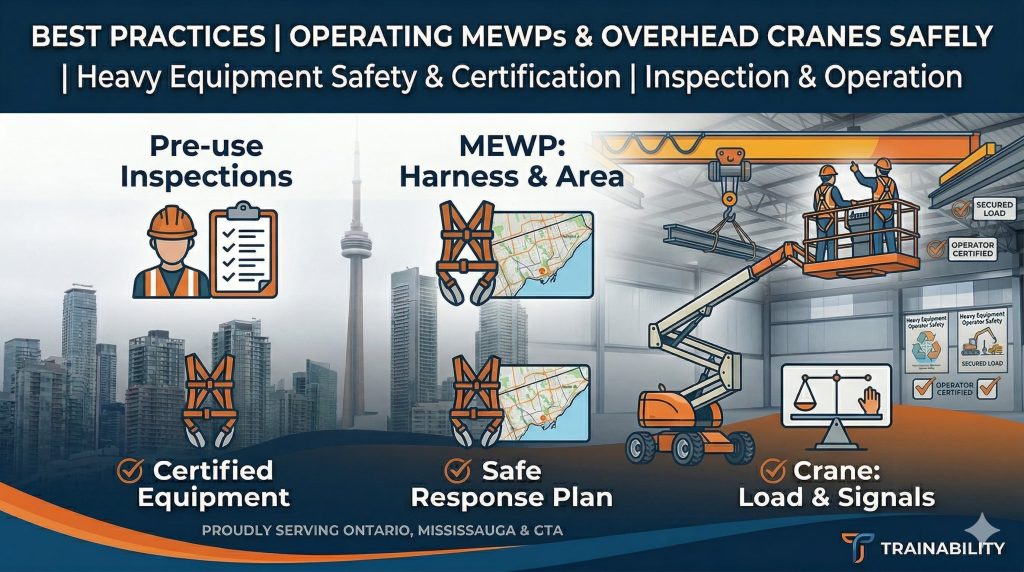
Mobility access and heavy lifting are vital in many industries such as construction, warehousing, and manufacturing. Mobile Elevating Work Platforms (MEWPs) and overhead cranes can often be used together in the same working environment, creating common safety hazards.
Employees are at an increased risk of injury if they have not received adequate MEWP training or been certified to operate a crane; this can include falling from heights, tipping over, dropped loads, and equipment failure. Efficiency is created through safe, controlled operations in a timely manner with adequate training.
MEWP Training: Avoiding Tip-Overs and Electrocution
To effectively operate mobile elevating work platforms, including both scissor lifts and boom lifts, it’s important to understand stability, terrain, and environmental hazards.
Scissor Lifts vs. Boom Lifts
Scissor Lifts
- Permits vertical only
- Suitable for use indoors or on flat surfaces
Boom Lifts
- Extend both out and up
- Used for reaching difficult-to-get-at places and outside work
Each type of equipment requires a different technique for handling. This type of training can be found from professional organisations that specialise in MEWP training programmes.
Key Safety Practices
Pre-Use Inspections
Before use, the operator shall inspect the following:
- Guardrails and platform control levers
- Hydraulic systems on the platform
- Tires and stabilisers
Preventing Tip-Overs
- Operate only on stable, level ground.
- Do not exceed the platform load limits.
- Avoid making sudden movements at height.
Avoiding Electrocution
- Always maintain a safe distance from overhead power lines.
- Be aware of potential overhead electrical hazards.
- Always use insulated tools when required.
When operators are properly trained, they can identify safety risks before they can become safety incidents.
Essential Skills for Overhead Crane Training
The focus of overhead crane training will be to master the skills required to lift loads safely and efficiently with minimum accidents in the workplace due to the level of precision, coordination, and load control that is necessary for safe lifts.
Core Skills Include:
Load Balancing
- Knowing how a load is distributed
- How to properly secure a load
- Prevent shift or swing during movement
Hand Signals & Communication
- Using clear communication between the operator and the ground crew
- Using standardized hand signals
- Preventing miscommunication in a noisy environment
Safe Lifting Techniques
- Lifting a load vertically and then moving it horizontally.
- Preventing sudden starts and stops when lifting or moving a load.
- Making sure that loads are within the safe operating limits.
Equipment Awareness
- Understanding the crane’s capacity and limitations
- Identify worn and damaged parts.
These skills can help to ensure the safe and efficient lifting of materials.
Why Overhead Hoist Training Prevents Catastrophic Equipment Failure
Cranes help in the movement of materials over larger areas, and hoists provide the actual mechanism for lifting these materials. Proper training for overhead hoist use is critical to ensuring the following:
Correct Load Handling: Preventing both the hoist and structure from being overloaded or experiencing unwanted stress.
- Routine Maintenance Awareness: To identify problems with a hoist before they lead to mechanical failure.
- Operational Precision: To minimise unnecessary stress placed on mechanical components.
- Emergency Preparedness: To have a quick response if there is an issue with the hoist.
Without hoist training, equipment breakdowns and dropped loads will not only lead to costly repairs but can also result in serious injuries to workers. Therefore, proper hoist training should be considered one of the most critical areas to train in and is often the most neglected.
Local Training Solutions in Mississauga and the Greater Toronto Area
In order for businesses located within Mississauga and throughout the G.T.A., it’s important to have access to training that is not only reliable but also complies with relevant regulations.
Providers such as Trainability produce the following:
- Certified MEWP training programmes
- Comprehensive Overhead Crane Training and Hoist Certification
- Practical experience through hands-on learning environments
- Onsite and in-class training specific to your industry
Providing training locally increases the likelihood that your staff will meet Ontario’s safety regulations and develop the confidence needed to operate in real-world scenarios.
Conclusion & Call to Action
MEWPs and overhead cranes can be operated safely only if they are operated by someone with proper training, hands-on experience, and compliance with regulations regarding operating MEWPs and overhead cranes.
By providing your employees with proper certification, you will:
- Decrease accidents in the workplace.
- Increase productivity
- Help to protect your employees and your equipment.
Now is the time to improve the safety of your operations!
Schedule your employees for MEWP and overhead crane training to ensure that they have the certification to work safely and are ready to perform their jobs.