Fires in the workplace can grow out of control within seconds. There is little time to react. Research indicates that the first 60 seconds of a fire emergency are critical. Quick thinking and proper training during this time can help reduce possible injuries, property damage, or death.
Fire safety training is an essential component of any organisation’s overall safety plan. It makes employees aware of fire hazards and prepares them for immediate action when needed.
Beyond the Alarm: The Core of Fire Safety Training
Fire safety training involves much more than simply hearing an alarm and exiting a facility. Effective fire safety training will ensure employees are given structured and practised responses.
Key Components:
Evacuation Routes
- Well-marked exits with adequate access.
- Regular drills to ensure everyone is familiar.
- Have designated assembly areas for headcount.
Fire Warden Duties
- Have an assigned person to assist with the following:
- Lead the evacuation.
- Ensure everyone exits safely.
- Assist emergency responders.
Emergency Procedures
- Employees should be able to distinguish between when to exit or respond.
- Employees should have clear lines of communication during an emergency.
- Employees should understand fire risks specific to their workplace.
A well-trained team will respond quickly and calmly, thus reducing chaos and confusion in the event of a real emergency.
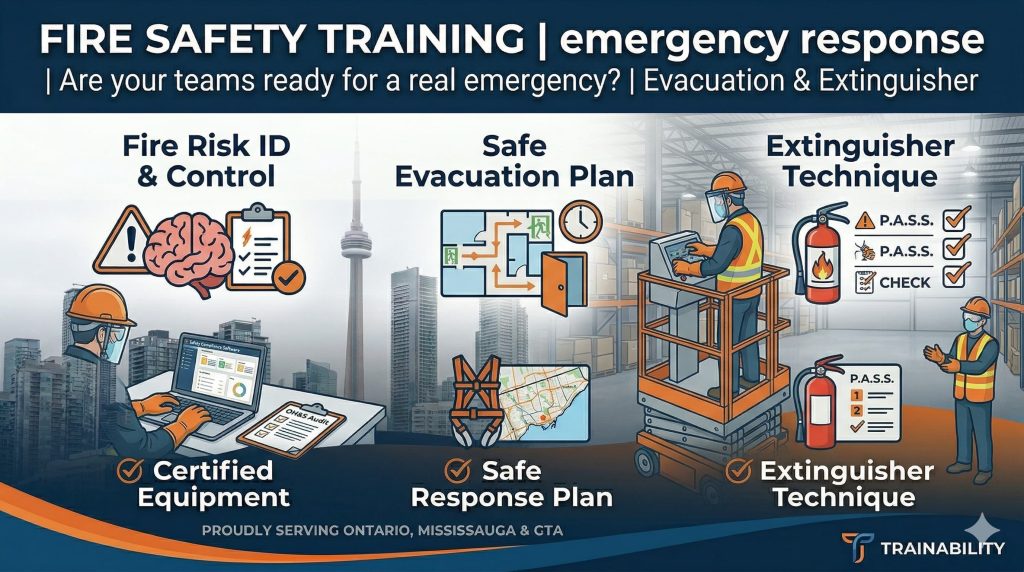
Hands-On Fire Extinguisher Training: The P.A.S.S. Method
It is essential to learn how to correctly use your fire extinguisher to prevent a small fire from becoming a catastrophic event. There are two key elements in fire extinguisher training: one is the technique, and the other is equipment selection.
P.A.S.S. Method:
- P = Pull the pin
- A = Aim at the base of the fire
- S = Squeeze the handle
- S = Sweep from side to side
Choosing the Right Fire Extinguisher:
- Class A = Wood and paper, ordinary combustibles
- Class B = Flammable liquids such as oil and gasoline
- Class C = Live electrical fires
- Class D = Combustible metal fires
- Class K = Cooking fires involving grease and oils
When an employee has hands-on training, they will accurately identify and properly use a fire extinguisher in an emergency situation.
Integrating Fire Safety into Your Occupational Health and Safety Management Plan
Never consider fire safety an isolated activity. It should form part of your overall occupational health and safety training programme.
Key Integration Steps:
- Complete regular fire risk assessments.
- Include fire response procedures within safety manuals.
- Conduct regular training/refresher sessions.
- Align with other emergency preparedness plans.
Integrating fire safety produces a complete safety culture, where employees are ready to deal with several kinds of workplace hazards.
Professional Safety Certification in the GTA and Mississauga
Professional training providers offer customised training programmes to meet compliance regulations for businesses in Mississauga and the Greater Toronto Area to achieve their business objectives.
Training offered by Trainability includes the following:
- Certified Fire Safety Training programs
- Practical fire extinguisher training
- Group customized workplace training
- On-site and in-class delivery models for flexibility
These programmes are provided to support an organisation’s ability to achieve the Ontario safety standard requirement and to allow employees to gain emergency response skills in real-world situations.
Conclusion & Call to Action
Preparation is the key to success in a fire situation; however, fire emergencies usually don’t give you much time to prepare before they actually happen; therefore, your employees need to be properly trained for it. Using fire safety training will allow your employees to act quickly, safely, and efficiently when responding to a fire.
Don’t wait until there is an emergency to find out if you are prepared.
Get a quote today for group fire safety training sessions and ensure your workplace is completely prepared for any potential fire situations.
FAQs (Frequently Asked Questions)
It is a training program for employee safety and prevention of a workplace fire.
Yes, especially those that work in an environment with a fire hazard and are responsible for responding to emergencies.
At minimum every 12 months, but depending upon the workplace regulation and specific hazards, workplace drills may need to take place more frequently.
The P.A.S.S. method is an easy way to remember how to use a fire extinguisher: Pull, Aim, Squeeze, Sweep.
Yes, many providers will provide customised training programmes to fit the specific hazards of each industry and/or workplace.