If you’re working on a construction site or at height anywhere in Ontario, then you must have received working at heights training as specified by the Ministry of Labour’s Safety Code. The Ministry of Labour states that no worker can work on a job site without first completing approved training when there is a chance of falling from an elevated height.
Falls are among the top causes of workplace injuries, thus making it necessary to have the proper certification under the law. Therefore, it is required by law to have trained workers who will save lives.
Book your Working at Heights Training in Mississauga

Here is You Need to Know How to Pass Working at Heights Training
- Ontario law states that construction workers who work at heights are required to have working-at-heights training.
- You must have completed a CPO-approved training programme.
- Your certification will be based on both theory and practical evaluation.
- You will need to have an understanding of the fall hazard, the legislation surrounding fall prevention systems, and how to properly use a fall prevention system.
- If you are prepared, your chances of passing on the first attempt are greater.
Module 1: Mastering the Theory (Working at Heights Training Basics)
The initial portion of your work-at-heights certification will cover basic knowledge about the protection of yourself and others from falling hazards.
Understanding Fall Hazards
There are many common situations that could pose a falling hazard:
- Unprotected Edge
- Fragile Surface
- Scaffolding and Ladders
- Open Shafts or Floor Openings
Establishing an awareness of how and where falls happen is a fundamental aspect of maintaining work safety for all employees.
Legislation & Regulations
Training for the use of equipment in the workplace (WAH) complies with Ontario’s construction standards established by the OHSA.
Basic objectives include:
- Duties and responsibilities of employers and workers
- Requirements for legal fall protection systems
- Fall protection must be used when working at heights of 3 metres (10 feet) or greater.
The Ontario Ministry of Labour’s safety standards enforce compliance, and enforcement of violations may have severe consequences.
The Hierarchy of Controls
The order of hazards must be understood.
- 1. Eliminating the Hazard
- 2. Using Guard Rails
- 3. Using Travel Restraint Systems
- 4. Using Fall Arrest Systems
- 5. Using Administrative Controls
The safest approach should always be considered before relying upon personal protection.
Module 2: The Practical Evaluation (Hands-On Preparation)
The actual aspect of the practical evaluation will be how well you can utilise fall protection equipment correctly.
Proper Harness Inspection
You should check the following items on your harness before you put it on:
- Straps: No frays or burns/cuts/chemical damage
- D-Rings: No cracks or distortion or rust
- Buckle: Functional & Secure
- Stitching: Tight, no loose/broken threads
Never use a harness if it is defective or damaged.
Calculating Fall Clearance
In order to compute the fall clearance, you need to compute a sufficient distance to avoid being in contact with the ground or a lower level.
The definition of fall clearance contains:
- Lanyard length
- Deceleration distance
- worker’s height
- safety factor
When calculations are incorrect, there is a danger of sustaining serious injury, even when using fall protection equipment.
Using Access Equipment
You will demonstrate that you can safely use the following:
- Ladders
- Scaffolding
- Elevated Work Platforms
Maintaining three points of contact during use and following proper tie-off procedures are common testing activities.
Top Tips to Pass the Written Exam
Tip 1: Don’t Rush Multiple-Choice Questions
Many of the questions on the exam will be scenario-based; therefore, please read thoroughly prior to selecting an answer.
Tip 2: Focus on Rescue Planning
Rescue plans can be very misunderstood; however, do not forget that if you are working with a fall arrest system, you must have a rescue plan established prior to starting work.
Tip 3: Know Your PPE Types
PPE consists of:
- Fall Restraint: Preventing you from getting close enough to be exposed to a hazard
- Fall Arrest: Stopping you from being injured after a fall has occurred
There are typically questions that appear on the exam for each one of these definitions.
Why Get Certified with Trainability?.
The choice of your working at heights provider is an important one. With CPO-approved training, you can ensure the following:
- Compliance with the Ministry of Labour
- Instructors with considerable experience
- Current learning materials
- Certification that is accepted and considered valid across Ontario
A reputable training provider will give you the confidence you need to succeed and work safely.
Frequently Asked Questions (FAQ)
The Working at Heights certification is the mandatory safety training that must be completed by individuals working on construction projects in Ontario who face a risk of falling.
All training must be completed through a CPO-approved provider in order to receive a valid working at heights certification from the Ministry of Labour.
The training provided will cover fall protection devices such as harnesses, lanyards, lifelines, anchor points, guardrails, and fall arrest systems.
If you understand the appropriate legislation, how to identify hazards, how to plan for rescues, and the PPE differences, the test will be fairly easy for you. If you review some test tips prior to taking the test, your chances of passing will certainly increase.
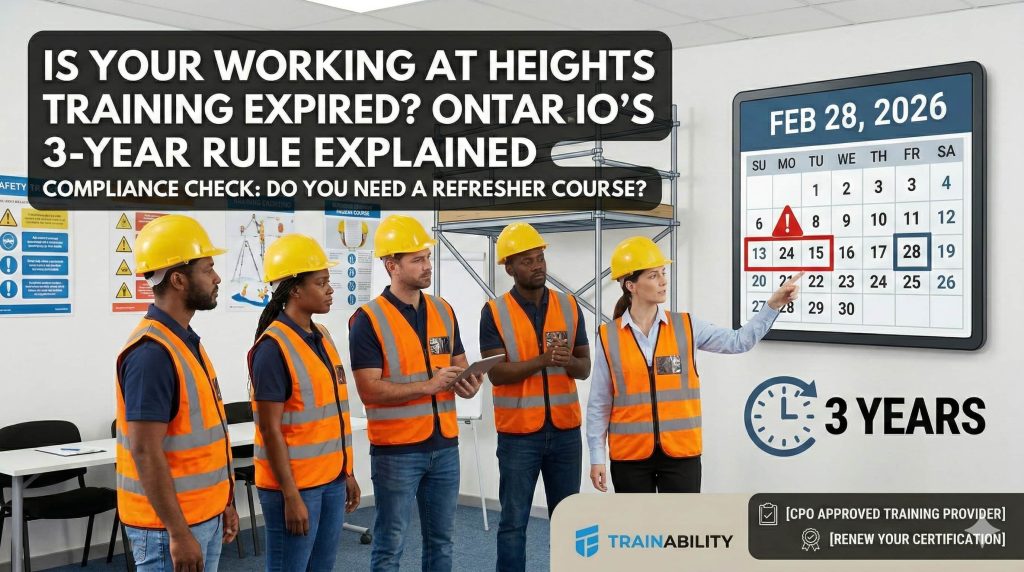
Certification for working at heights is generally good for three years from the date of completion; after that, you will need to complete the course again in order to maintain your certification.
Conclusion
The training programme teaches participants how to prevent injury or death while working at heights. Once participants complete the training sessions and have passed their exam, they can return to work and fulfil their responsibilities with safety in mind through their knowledge of current Ministry of Labour safety regulations as well as their ability to operate properly with fall protection equipment.
Complete the application process today, and you will be prepared for your working at heights training certification.