
Why a Working at Heights PPE Checklist is Your Last Line of Defense
The first priority when working at heights is to prevent yourself and others from falling or being injured. The personal protective equipment (PPE) that you are provided -as detailed in a comprehensive working at heights PPE checklist – to protect yourself from falling and sustaining an injury is your last line of defence if something goes wrong.
In Ontario, the safety regulations that you must follow are to receive adequate training and use an approved Ontario Construction Safety Association (OCSA) standard for construction safety gear. Understanding how your fall protection PPE works, how to use it, and when to replace it will ultimately determine whether you experience a near miss or life-threatening incident.
Book your Working at Heights Training in Mississauga
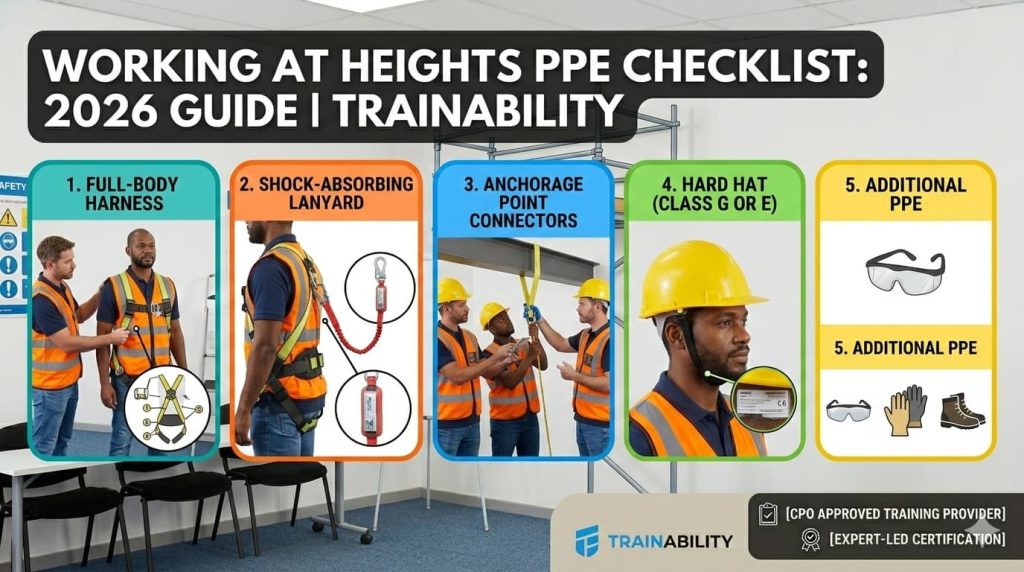
The Core Four: Essential Gear for the Course
An appropriate working at heights course contains the four most important parts of a fall arrest system:
- Full Body Harness
- Must be certified by CSA.
- The D-ring must sit between the shoulder blades properly.
- It has a proper snug fit to avoid shifting during a fall.
Why the fit is important:
If your harness is not fitted to your body properly, you can experience suspension trauma, a medical condition caused by blood pooling in the legs when you are suspended in mid-air. When your harness is adjusted correctly, it will properly distribute the force of the fall on your legs and torso.
It is very important that you regularly inspect your safety harness for damage to the straps, buckles, or webbing.
- Connecting Components (Lanyards & SRDs)
All lanyards or devices used to connect your harness to an anchor point are included in your fall-arrest equipment inventory.
- Shock-Absorbing Lanyards: Expand in order to limit fall impact rate.
- Self-Retracting Devices (SRDs): Lock automatically at the moment of sudden falling and thus limit your distance of free fall.
Pro Tip: Calculating Fall Clearance
The following items should always be calculated:
Worker Height + Lanyard Length + Deceleration Distance + Safety Factor
Calculating clearance incorrectly for fall protection is one of the most frequent ways that accidents occur with this equipment while working at heights.
- Anchor Points
Anything that has been anchored is only as strong as its anchorage point.
The standard rule: a minimum strength of 5,000 lbs per person attached to an anchor.
Whatever attachment point is used (structural support member) must be verified prior to attaching a lanyard system.
- Head & Foot Protection
Standard hard hats are not enough for work at height.
- Standard hard hats offer little protection, so they must be secured with a chin strap.
- All slip-resistant and safety shoes must be CSA-approved for proper use.
Proper fall protection PPE should be designed from the head down, including all danger zones.
The Pre-Use Inspection Checklist (Step-by-Step)
Before every shift, you must perform the following inspection of your safety harness: –
- WEBBING: Look for cuts, burns, frays, and/or chemical damage.
- STITCHES: Look for pulled, loose, or broken threads.
- HARDWARE: Look for cracks, distortion, or rust on D-rings and buckles.
- MARKING: Ensure legible tags and check the Date of First Use
The regular inspections will help to ensure that your fall arrest equipment list is compliant and safe to use.
Get Hands-On Training in your city/region
Are you searching for a quality working-at-heights training programme near you? Well, Trainability provides high-quality equipment for construction safety (Ontario) on a daily basis along with professional types of equipment for all the practical evaluations.
Our instructors demonstrate real-world PPE for height-safety applications, ensuring you gain hands-on confidence.
Trainability is located at a convenient location for employees within a reasonable drive range. You can review Trainability’s website and see current class schedules or see pictures of our students on the Google Business Profile.
To find directions to Trainability and to read the 5-star rating review, use “Trainability” on Google Maps.
Training Beyond the Harness
High-quality working-at-heights training will emphasise that personal protective equipment (PPE) is not limited to fall protection.
- Respiratory Protection: Respirators may need to be used when entering confined spaces.
- Eye & Face Protection: There are specific types of eye & face protection that must be worn when using machines with guards.
- Electrical Safety Awareness: Require additional PPE when working with arc flash hazards.
Integrated safety training helps workers understand all controls for hazards, not only those related to falling.
Common PPE Mistakes to Avoid
Even experienced workers can make mistakes that could have been avoided:
- Wearing an improperly fitted harness (higher chance of falling out during a fall).
- Failing to check the expiry date on soft goods such as lanyards, webbing, etc.
- Mixing components from different manufacturers without verifying compatibility.
- Not completing daily safety harness inspection procedures.
Proper education will greatly reduce these risks.
Conclusion
Completing the appropriate accredited working-at-heights training course provides you with the skill and knowledge necessary to both wear your gear properly and safely inspect, determine, calculate, and connect your fall protection system correctly. These include all component/safety items, from anchoring points to head protection.
If you’re looking to improve your safety knowledge, register now for our next Working at Heights course using commercial-grade equipment.
FAQs (Frequently Asked Questions)
Full body harness, shock-absorbing lanyard, or self-retracting device; certified anchor point; hard hat with chin strap; footwear marked CSA approved.
Prior to each use (with formal, documented inspections carried out by company policy).
Each anchor point must be capable of supporting at minimum 5,000 lbs for every worker attached.
The worker may strike the lower level despite wearing fall protection.
Yes, it is required for all employees who are exposed to falling hazards as defined in provincial regulations.

