Many people think that fall protection training is the same as training for working at heights, but they are NOT interchangeable trainings. If you book one of these courses incorrectly, you could find yourself failing inspections, being denied access to a work site, and/or violating a provincial safety regulation.
The purpose of this guide is to clarify the five key differences between Working at Heights vs. Fall Protection certification to help you select the correct course so that you remain compliant and avoid expensive mistakes.
If you work in Ontario in the construction industry, understanding how fall protection is different from working-at-heights certification is not an option; it’s mandatory!
Book your Working at Heights Training in Mississauga

Legal Requirements & Compliance
Working at Heights Course:
Workers engaged in construction projects in Ontario must complete a Working at Heights course, which has CPO-approved training. This means the course meets the standards created by the Chief Prevention Officer in accordance with Ontario’s regulations.
The Ministry of Labour, Immigration, Training and Skills Development oversees the programme, and enforcement is aligned with those established by Construction Safety Ontario.
Without this certification, the following will occur:
- Workers could be removed from the site.
- employers will incur fines
- projects will be interrupted.
The certification is regarded as a workplace safety certification.
Fall Arrest Training:
Fall arrest training focuses on how to operate a system that prevents falls (i.e., using harnesses, anchors, and/or lifelines). It is a critical safety measure and cannot take the place of the Working at Heights course offered to workers on construction sites, which is required by law.
Fall arrest training is:
- Employer required
- Niche-specific
- Equipment-specific
However, working alone does not guarantee that an employer will be compliant with construction law.
Key Difference
- Working at height is equal to a legal requirement.
- Fall arrest is equal to equipment-based training.
The Scope of the Curriculum
The “Pillar” Approach: Working with Heights Course
A full working-at-heights course is developed according to the hierarchy of controls, which are the basis of a safe work environment. It covers: –
- Elimination: Completely remove a fall hazard from the workplace.
- Prevention: Installing guardrails and barriers
- Restraint: Preventing workers from reaching the fall edge.
- Arrest: Stopping the fall if it occurs.
This is a complete training programme to prevent workers from falling, not only after they have fallen.
As part of this training, workers will be taught to:
- Recognise hazards
- Assess risk
- Understand the law and their responsibilities
- Plan for rescue
- Install and use equipment correctly.
In essence, this is an education about safety in relation to the entire system.
The “Tool” Approach: Fall Arrest Training
Fall arrest safety training has an emphasis on the last stage of the fall: stopping the person from falling.
Training usually consists of the following:
- Harness fitting
- Anchor selection
- Lanyards and Lifelines
- Operation of fall arrest systems
- Energy absorbers
Fall arrest training is a very specialised and practical method of training that is based around the equipment.
Fall arrest training does not always have the following:
- Strategies for broader hazard elimination;
- Full regulatory education;
- All legal compliance education.
To put this another way:
- A working-at-height course is a safety system.
- Fall arrest training is a safety tool.
Practical Hands-On Requirements
A working at heights course includes a mandatory practical evaluation. This Involves: –
- Proper use and fitting of a harness
- Inspection of straps, D-ring, stitching, and buckles
- Connection to approved anchor points
- Demonstrating proper tie-off techniques
- Basic setup of a fall arrest system
A hands-on demonstration is required for completion of the course.
Fall arrest training can contain practical components, but requirements vary from provider to provider and from employer to employer.
Important Differences:
- Working at heights requires a standardised practical assessment.
- Fall arrest training can have greatly differing structures and intensities.
Certification Validity and Renewal
The 3-Year Rule
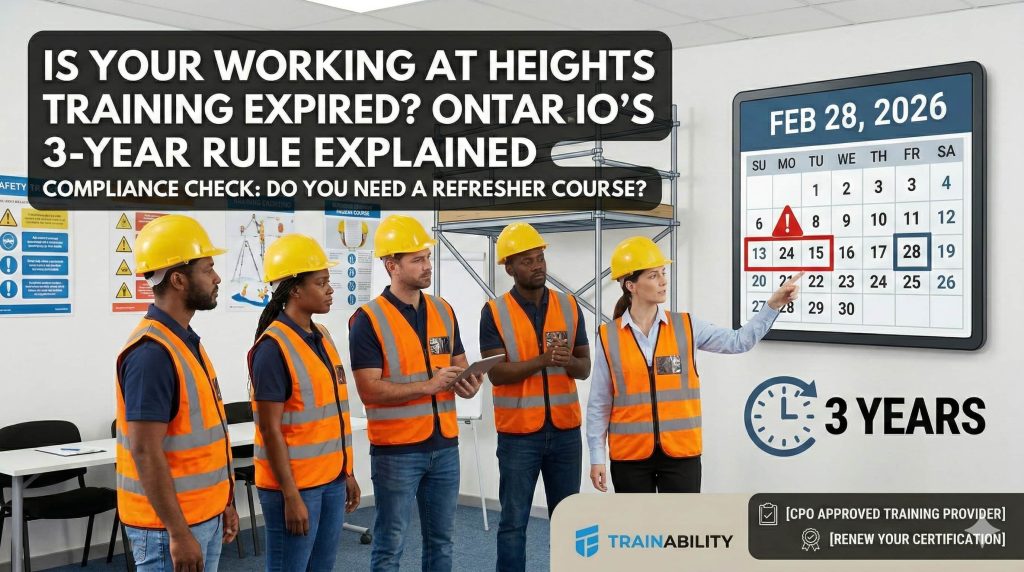
Generally, the certification for the Working at Heights course will only be valid for 3 years; therefore, you must complete a refresher course to remain compliant after 3 years.
This ensures workers stay updated on:
- Changes in regulations
- Improvements in safety procedures
- Any new equipment standards
If you do not renew your certification, you may not be allowed to access the job site.
Continuous Learning
In addition, you may also require other training/certifications specific to your position, including
- Training to work in a confined space
- Operating an overhead crane
- First Aid/CPR Certifications
Fall arrest certification validity varies by employer or equipment policy and is often less standardised.
Industry Application (Construction vs. Industrial)
Construction Sites
If you work in Ontario on a construction site, you will require the complete Working at Heights Course (WAH).
An inspector will generally ask for the following:
- A valid CPO certificate
- Proof training date
- Refresher documentation
If you do not have this documentation, you most likely will not be able to work.
Industrial or Equipment-Specific Work
In warehouses, telecommunications, utilities, and manufacturing settings. If the task performed is at an elevation in the work environment, fall arrest training may be required.
Additionally:
- Training based upon equipment used.
- Employer policy would apply.
- Regulatory requirements differ from construction regulations.
Summary Table for Quick Skimming
| Feature | Working with Heights Course | Fall Arrest Training |
| Legal Status | CPO/Ministry-Approved | General Safety Standard |
| Primary Goal | Fall Prevention & Arrest | Stopping a Fall in Progress |
| Mandatory For | All Construction Projects | Specific Equipment/Industrial Use |
| Validity | 3 Years (Official Certificate) | Varies by Employer/Equipment |
| Hands-on Eval? | Mandatory | Recommended/Tool-Specific |
Why Choosing the Right Course Matters
Safety First
The leading causes of serious injuries at the workplace are falls and stair falls; train properly to reduce risk, improve hazard awareness, and be prepared for an emergency.
Avoiding Fines
Avoiding the consequences of non-compliance can lead to the following:
- Significant penalties
- Work suspension
- Legal liability
Selecting the right certification can prevent expensive mistakes.
Trainability’s Edge
A qualified provider will provide your employees with:
- CPO-approved instruction
- Experienced trainers
- Hands-on harness training
- Adequate documents to maintain the inspection report
This positions your company as safety-focused and compliant.
Conclusion
Working at heights is a required, full, and valid safety certificate for all construction sites under applicable laws.
Fall arrest only includes training on specific pieces of equipment and does not substitute for the total certificate requirement.
Check with your job site to determine which training is required under the law prior to booking it. This can save you money, time, and possibly the risk of injury.
Frequently Asked Questions (FAQ)
Fall arrest training is about the use of the equipment, and working at heights training is about fall prevention and meeting legal requirements.
Yes. All construction workers must have their working-at-heights certifications, which are CPO-approved, in order to meet provincial requirements for training.
A working-at-heights certificate is usually valid for a 3-year period; you will require a refresher course after the 3-year period.
Yes, harness training and equipment inspections are mandatory components of the hands-on portion of the course.
Fall protection training cannot be replaced on construction sites. It may complement it but does not replace the necessary certification.